President Ryan is apparently blind to the fact that in America, and at public colleges like BCC, people enjoy freedom of speech and conscience, which means that they cannot be compelled to respect each other or to refrain from expressing their disrespect. Besides, it’s hard to imagine this code being enforced indiscriminately. Would students be punished for disrespecting the views of neo-Nazis, or even neo-conservatives who mock affirmative action?
If President Ryan actually believes what this code implies -- that students should be taught that all political ideologies, creeds and “lifestyle orientations” are equal, and demand equal respect – then his “vision” of higher education is stupefying. Students are supposed to be taught that all ideas are not equal; they’re supposed to learn how to judge the merits of different and conflicting ideas and how to back up their judgments with reason. Mindless respect for all points of view is not an element of critical thinking.
Thursday, February 14, 2008
Are Colleges Becoming Too PC?
Fortunately, this public college is not representative of US colleges (yet, anyway) but still, THIS is coming from the president of an institution who purports to promote intellectual pursuits??


Wednesday, February 13, 2008
The biggest threat to America?
No, not the terrorists; they can only claim a few lives and this will never destroy our country -- it would just make us stronger. What could destroy the country? Well, giving up our ideals -- as this candidate is not only willing to do but actually advocating:
"I have opponents in this race who do not want to change the Constitution," Huckabee told a Michigan audience on Monday. "But I believe it's a lot easier to change the Constitution than it would be to change the word of the living god. And that's what we need to do -- to amend the Constitution so it's in God's standards rather than try to change God's standards so it lines up with some contemporary view."
Who is more moral?
From NYT:
Which of the following people would you say is the most admirable: Mother Teresa, Bill Gates or Norman Borlaug? And which do you think is the least admirable? For most people, it’s an easy question. Mother Teresa, famous for ministering to the poor in Calcutta, has been beatified by the Vatican, awarded the Nobel Peace Prize and ranked in an American poll as the most admired person of the 20th century. Bill Gates, infamous for giving us the Microsoft dancing paper clip and the blue screen of death, has been decapitated in effigy in “I Hate Gates” Web sites and hit with a pie in the face. As for Norman Borlaug . . . who the heck is Norman Borlaug? Yet a deeper look might lead you to rethink your answers. Borlaug, father of the “Green Revolution” that used agricultural science to reduce world hunger, has been credited with saving a billion lives, more than anyone else in history. Gates, in deciding what to do with his fortune, crunched the numbers and determined that he could alleviate the most misery by fighting everyday scourges in the developing world like malaria, diarrhea and parasites. Mother Teresa, for her part, extolled the virtue of suffering and ran her well-financed missions accordingly: their sick patrons were offered plenty of prayer but harsh conditions, few analgesics and dangerously primitive medical care.
Which of the following people would you say is the most admirable: Mother Teresa, Bill Gates or Norman Borlaug? And which do you think is the least admirable? For most people, it’s an easy question. Mother Teresa, famous for ministering to the poor in Calcutta, has been beatified by the Vatican, awarded the Nobel Peace Prize and ranked in an American poll as the most admired person of the 20th century. Bill Gates, infamous for giving us the Microsoft dancing paper clip and the blue screen of death, has been decapitated in effigy in “I Hate Gates” Web sites and hit with a pie in the face. As for Norman Borlaug . . . who the heck is Norman Borlaug? Yet a deeper look might lead you to rethink your answers. Borlaug, father of the “Green Revolution” that used agricultural science to reduce world hunger, has been credited with saving a billion lives, more than anyone else in history. Gates, in deciding what to do with his fortune, crunched the numbers and determined that he could alleviate the most misery by fighting everyday scourges in the developing world like malaria, diarrhea and parasites. Mother Teresa, for her part, extolled the virtue of suffering and ran her well-financed missions accordingly: their sick patrons were offered plenty of prayer but harsh conditions, few analgesics and dangerously primitive medical care.
IT MATTERS WHAT CANDIDATES THINK
While I do care about candidate pandering and worse, stupidity, in denying that they don't "believe in evolution," there's even a bigger issue at stake. Quick sidenote, however; I'm aghast that we have thousands of scientists with possibly billions of data points that ALL AGREE that evolution is not only possible but perhaps the only rational explanation of how life has reached its current stage of development -- but they don't "believe" it?? WTF!? I take it that they are instead choosing to believe something that they heard from their parents when they were a child that some special book interpreted metaphorically suggests that maybe life evolved some other way -- without any concrete supporting data points.
So this type of non-thinking is much more informative of the type of thinking that we can expect from our leaders -- and this is the crucial point, from this article at Reason.com:
So this type of non-thinking is much more informative of the type of thinking that we can expect from our leaders -- and this is the crucial point, from this article at Reason.com:
A larger question is whether a candidate's belief about the validity of evolutionary biology has anything to say about his or her ability to evaluate evidence. A January 4, 2008, editorial by Science editor Donald Kennedy correctly argues, "The candidates should be asked hard questions about science policy, including questions about how those positions reflect belief. What is your view about stem cell research, and does it relate to a view of the time at which human life begins? Have you examined the scientific evidence regarding the age of Earth? Can the process of organic evolution lead to the production of new species, and how? Are you able to look at data on past climates in search of inferences about the future of climate change?" Kennedy concludes, "I don't need them to describe their faith; that's their business and not mine. But I do care about their scientific knowledge and how it will inform their leadership." Since science and technology policy issues are only going to become more important as the 21st century unfolds, we should all care how scientific knowledge informs a president's leadership.
How is this political choice?
We can choose from corporate Republicans or corporate Democrats, each beholden to their parties, their donors and the lobbyists. So who then is supposed to be beholden to the people?
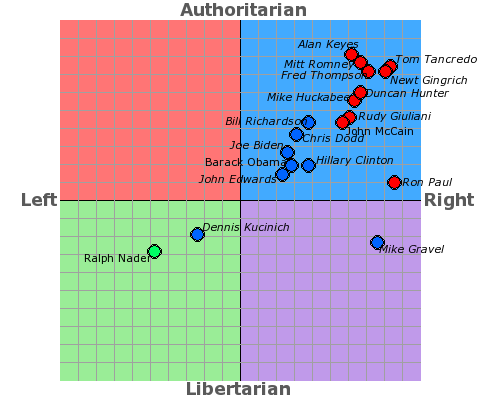 Thanks.
Thanks.
France Best? US Worst? Unfortunately, yes.
And not just in cheese eating, but something much more important (and I love cheese!). According to a recent study, France, Japan and Australia rated best and the United States worst in new rankings focusing on preventable deaths due to treatable conditions in 19 leading industrialized nations. And ironically, we pay more!
Sunday, February 10, 2008
Bush Must Go - by George McGovern
Why I Believe Bush Must Go
Nixon Was Bad. These Guys Are Worse
by George McGovern
A President, any President, who maintains that he is above the law — and repeatedly violates the law — thereby commits high crimes and misdemeanors.
Saturday, February 9, 2008
Steal This Film
StealThisFilm2 has a great summary of how the flow and copying of information has developed through history. It's important that people understand that copyright is intended as a PUBLIC BENEFIT by providing LIMITED short-term rights to the author in order to encourage innovation. It's NOT intended to provide a perpetual mechanism for the few to make a profit by restricting these items from the public domain. Watch it.
This version is much better than the orginal Steal This Film, which covered the brief shutdown of PirateBay.
This version is much better than the orginal Steal This Film, which covered the brief shutdown of PirateBay.
We need an attitude adjustment
Never forget, businesses exists to the extent that they benefit the public and what they are allowed to do is controlled by laws enacted by the public.
When it comes to governance the only voice we should listen to is that of individuals who want to suggest ways in which certain policies can help insure that business benefits the country. What is good for business is not always good for the country in spite of what Republicans and Corporate Democrats may say. We need to separate the what is good for the country from the what is good for the amoral often immoral best interests of a legal structure that defines how a business operates. Jon Edwards understands this, I'm not sure the others do. Many corporations are stealing what is good about the United States. They must be stopped.Thanks 1gm.
Friday, February 8, 2008
Belief in Belief
A question that interests me very much (and always has) is this: I know that I do not believe in either any god or any religion, and I can give my reasons in a manner that the other side can at least understand, but can the same be said for those who claim that they do believe? A shorter way of putting this is to ask whether our antagonists in this ancient argument truly mean what they appear to say.It's sad how many people jump to the conclusion that faith automatically elevates our morality, even when there are so many separate points of strong evidence to the contrary.
Monday, February 4, 2008
Rocky, Nader call on Demos to stop Clinton
Salt Lake City Mayor Rocky Anderson joined Ralph Nader on Monday in lambasting Hillary Clinton as a stooge for big business who should be stopped from capturing the Democratic nomination for president. "Do you really believe if we replace a bunch of corporate Republicans with a bunch of corporate Democrats, that anything meaningful is going to change?" the statement asks. "This has to stop. It's that simple."
It's true, coporate giants and political greed have reached new heights and will consume the planet. If concerned minds don't speak up soon, it will be too late.
You may not be able to find the original article any longer but Google has a cached copy (for now).
Sunday, February 3, 2008

Wednesday, January 30, 2008
Truth was first US casualty in Iraq war
Two articles on the same new study that show how the President George W. Bush and his top officials waged a carefully orchestrated campaign of misinformation about the threat posed by Saddam Hussein's Iraq, lying a total of 935 times in order to prepare the public to support their intent to wage war! If that's not one of the most despicable actions that you've ever heard perpetrated in the name of the American public then I'd like to know -- so please Comment.
Once again, CH says it like it is
Christopher Hitchens, interviewed last month makes several good points. Here's his parting commentary on why many need religion:
Look, the whole point about religious faith, in my opinion, is that it's not possible to imagine us ever living without it, or eradicating credulity. We are a credulous species. We're programmed to look for patterns, which is a good thing, because it's enabled all our progress and all our innovation. The problem is that people will take a junk pattern over no pattern at all. Just as they'll prefer a conspiracy theory to having no opinion. And religion is a huge help in doing that. Like astrology: "Well now, come to think of it, the movements of those heavenly bodies are just out there to determine what I'm supposed to do on Friday. How simple it all now seems. How nice that is, by the way, that this vast business should be set in motion just to advise me on my career moves."
But it makes sense to individuals, because they have a high opinion of themselves. Religion also flatters our solipsism, and our selfishness, and our self-centeredness, while pretending to teach us to be modest. That's the joke of it. By pretending to say, "Be modest and humble," it promotes the most fantastic arrogance and self-centeredness and conceit. I find that quite amusing. It also trades on the fear of death. And that is a pretty good selling point. I'm not afraid of death myself, because I'm not gonna know I'm dead. I'm awed a bit by the idea, but I'm perfectly reconciled to it. Certainly I am, as everyone is, reconciled to everyone else's death but their own. They think an exception can be made in their own case. And religion encourages them to believe something as absurd as that. You can sit in the airport and watch everyone go by, and think, "Yes, if they make the right noises, they'll get eternal life." Isn't that a nice idea? No, they don't want it for them, they want it for themselves. So religion is this corrupt racket, but it can't fail because there will be infinite demand for that. Religion will die out when we stop worrying about death.
Look, the whole point about religious faith, in my opinion, is that it's not possible to imagine us ever living without it, or eradicating credulity. We are a credulous species. We're programmed to look for patterns, which is a good thing, because it's enabled all our progress and all our innovation. The problem is that people will take a junk pattern over no pattern at all. Just as they'll prefer a conspiracy theory to having no opinion. And religion is a huge help in doing that. Like astrology: "Well now, come to think of it, the movements of those heavenly bodies are just out there to determine what I'm supposed to do on Friday. How simple it all now seems. How nice that is, by the way, that this vast business should be set in motion just to advise me on my career moves."
But it makes sense to individuals, because they have a high opinion of themselves. Religion also flatters our solipsism, and our selfishness, and our self-centeredness, while pretending to teach us to be modest. That's the joke of it. By pretending to say, "Be modest and humble," it promotes the most fantastic arrogance and self-centeredness and conceit. I find that quite amusing. It also trades on the fear of death. And that is a pretty good selling point. I'm not afraid of death myself, because I'm not gonna know I'm dead. I'm awed a bit by the idea, but I'm perfectly reconciled to it. Certainly I am, as everyone is, reconciled to everyone else's death but their own. They think an exception can be made in their own case. And religion encourages them to believe something as absurd as that. You can sit in the airport and watch everyone go by, and think, "Yes, if they make the right noises, they'll get eternal life." Isn't that a nice idea? No, they don't want it for them, they want it for themselves. So religion is this corrupt racket, but it can't fail because there will be infinite demand for that. Religion will die out when we stop worrying about death.
Subscribe to:
Posts (Atom)


